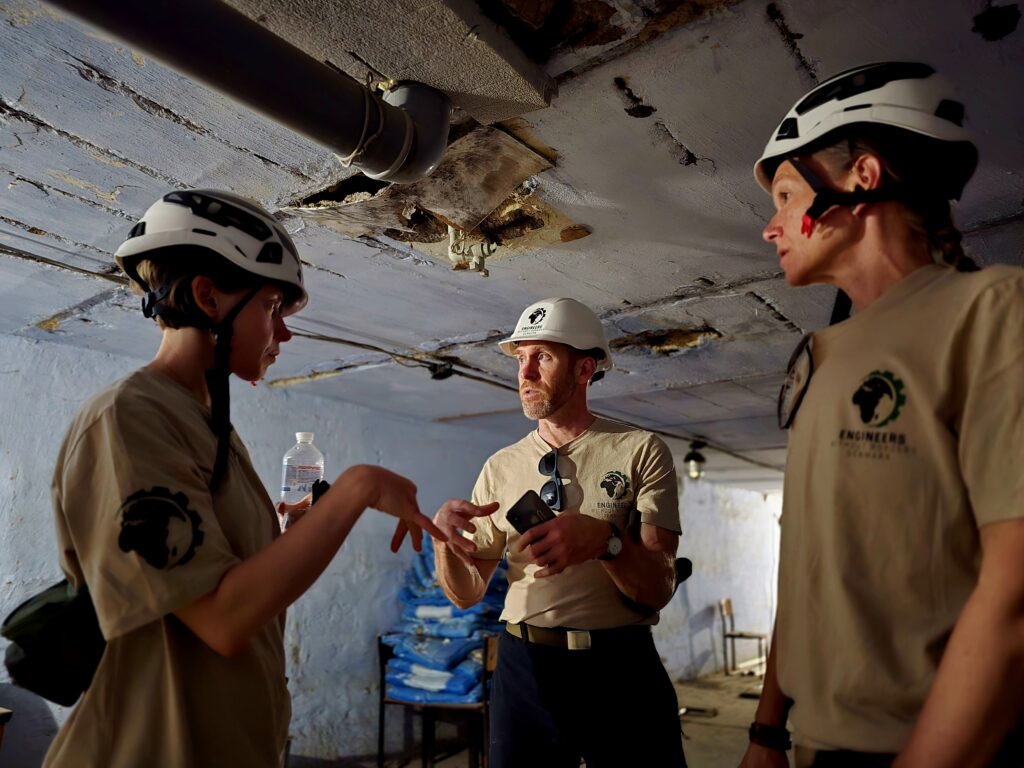
The team travelled to inspect local water towers and to see the completed result of a year’s work at a summer camp near Sofiivka. Over the past year, Engineers Without Borders Denmark has helped establish both clean drinking water and solar panels to provide electricity at the camp.
The trip also had a third, long-awaited and festive purpose: to take part in the inauguration of the summer camp, which now has both water and electricity as it welcomes the many groups of children visiting throughout the summer.
For the small local community, the camp is far more than a summer holiday activity. It is a safe space for children living with the realities of war, and ensuring access to water and electricity at the camp has therefore been a high priority.
“It was amazing to see all the children starting a new season, to see how happy they were to meet each other again and to have the opportunity to spend part of their summer at the camp,” says Yaroslava, who herself grew up in Ukraine under more peaceful circumstances. This is her third visit to the camp with Engineers Without Borders Denmark.
The two deployed operations engineers, Julian and Preben, were also very pleased with the now completed project in Sofiivka.
“Everything was running. There was clean water, we got water from the taps, and it tasted great. It worked even better than expected,” says Julian.
He also clearly sensed how much the project has meant locally: “We could really feel that they were grateful for the work we have done. The mayor was truly happy with what we had done for them.”
There were 90 children at the summer camp while the team was visiting. The plan, however, is to expand capacity so that in the future the camp can welcome up to 150 children at a time.
Preben also highlights how important the collaboration with local skilled workers has been in bringing the project across the finish line: “They are very capable local contractors. Really fine craftsmanship. They had adapted the solutions so they suited their needs even better. Very professional.”
But the trip also gave the team an insight into the very reality the children get a break from when they are at the camp. The air-raid siren sounded several times, and the team had to go to the shelter twice in one day. Fortunately, they took the experience in their stride.
“I don’t think it affected me much – apart from the fact that it was annoying to get less sleep,” says Julian. “It was clear to see that the local population is used to it. The second time we were in the bunker, we were the only ones sitting down there. Of course, the locals are affected when you can see the drones, but the air-raid sirens themselves are something they no longer react to very much.”
One thing that has made a strong impression on both Julian and Preben during their missions to Ukraine is the way people remember the victims of the war in the middle of a busy everyday life.
“At 9 o’clock every morning, everyone stops what they are doing and stands completely still for one minute. Then the national anthem is played, and people stand with their hands on their hearts. Everything stops, including the traffic. This is when they remember the fallen,” says Preben. “And then everyday life continues afterwards. It is something people take very seriously.”
During the trip, Julian had several long conversations with the team’s driver through an interpreter. It gave him a powerful insight into the human consequences of the war.
“I got a very strong impression of their situation. It is tough stuff. The driver had been in the army and had been discharged because he had been injured several times. And our local interpreter was only 20 years old. If there was thunder, she would flinch because she has experienced so many drones.”
Meeting the Ukrainians and seeing the circumstances they live under has made a deep impression on both Julian and Preben. The children, who are allowed to be children for a while at the camp, and the adults, who continue to keep everyday life going in the midst of the seriousness of war.
Even so, they have not been discouraged by a trip with air-raid sirens and visits to shelters.
“I feel completely safe when we are deployed,” says Julian.
“I always say that traffic is the most dangerous thing when we are over there,” adds Preben. “The roads are not in good condition.”
Both emphasise that they felt in safe hands throughout the entire trip. They were in daily contact with our mission coordinator, Lasse, who followed the situation closely.
“He is always on top of things. He tells us when there is an alert, and it is reassuring to know that you can always write to Lasse and get an answer straight away,” says Julian.
So, after this trip, would they be ready to go again if needed? The answer from both is clear.
“If there is a need, then of course we are ready to go again,” they say in unison.